Features Overview
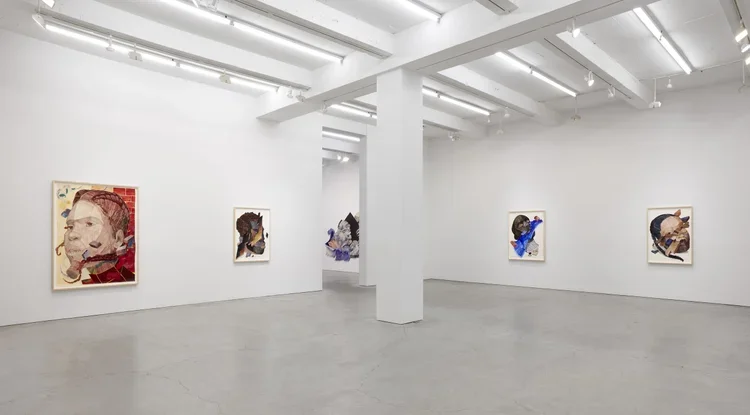
Proposal for a Monument: 2026
Sikkema Malloy Jenkins - New York City
In his practice, Yashua Klos explores how identity—particularly Black identity—is constructed as a means of survival, adaptation, and empowerment. Proposal for a Monument features a selection of recent large-scale woodblock print collages. In this body of work, Klos revisits imagery he first began exploring in 2015, of dimensional portrait busts intersected by grids, planes, wood, and concrete blocks. The integration of building materials and architectural elements into the collages alludes to the built environment, and specifically to the urban area of Klos’s hometown, Chicago—a city indelibly shaped by its signature street grid as well as by legacies of segregation and housing discrimination. The anonymized subjects of Klos’s collages are placed in constant negotiation with the material symbols of these unjust systems, entangled within their wreckage yet at times breaking through or reclaiming it as scaffolding to support the construction of something new.
Klos’s latest body of collages expands upon his earlier explorations of survival strategies to propose presence itself as a monument of resistance. History has shown that monuments, as both structures and symbols, are not infallible; what, Klos asks, might replace them? The exhibition’s title leaves the answer as an open-ended proposal, invoking a framework of monumentality that transcends fixed conditions or static forms. At a moment when Black and brown bodies are increasingly cast out from public space and Black figuration faces a downturn in the contemporary art landscape, Klos envisions a radical “hyper-visibility” of marginalized individuals constructing images in their own likeness.
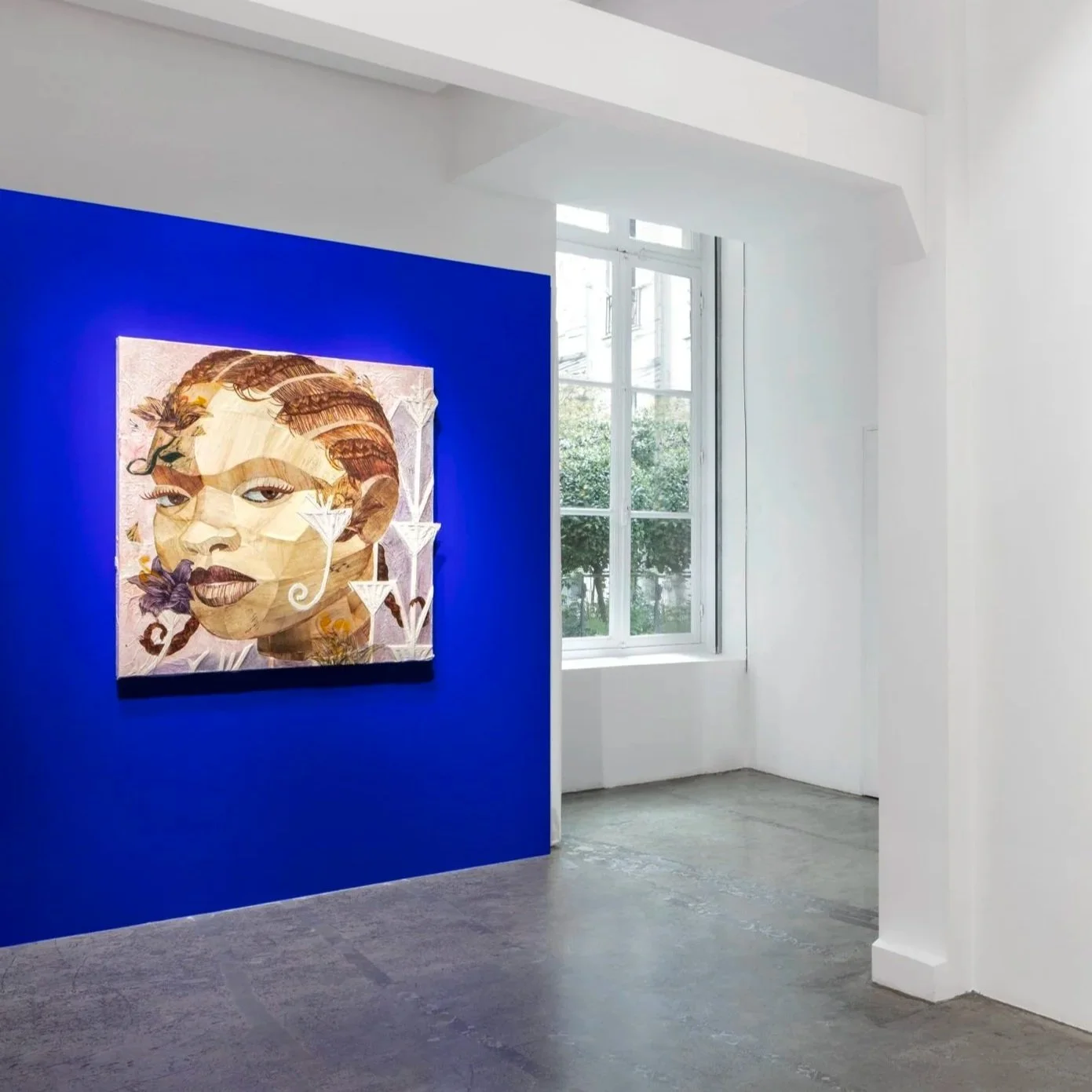
Building our Being: 2023
Zidoun-Bossuyt Gallery - Paris
In his second solo exhibition with the gallery, and his debut at Zidoun-Bossuyt’s Paris location, Klos continues to evolve his sui generis collage constructions. Building images from his own woodblock printed source material, his work features a new element — wooden sticks enveloped in Japanese rice paper. As much as this choice of material echoes the deep roots of printmaking, it also exemplifies Klos’ gesture of both honoring and breaking with traditional art making processes. Similarly, Klos bends the convention of portraiture to stage his exploration of ‘identity-as-construct’. Each visage of his subjects is a hybrid; drawn from a composite of found photos, images of friends, and familial memories. Here, portraiture is less about likeness, but more an opportunity for subjective and ambitious storytelling.
In the show’s title, Klos’ reference to ‘Building’ is threefold. Firstly, ‘Building’ is the very act of constructing cities across the American Midwest through the industrial labor of a migrated Black population. As a verb, ‘Building’ refers to the process of constructing one’s identity from the influences in one’s own environment. And finally, as a noun, the word references the Art Deco buildings themselves, signifying Detroit’s collapsed capitalist promise. Woodblock printing, a medium richly steeped in African American art tradition and frequently used for creating political posters and pamphlets, and illustrations is a cornerstone of Klos’ practice. Following in the footsteps of revered artists such as Elizabeth Catlett and Charles White, Klos reimagines the portrayal of the Black figure within this medium. Unlike Klos’ predecessors, his figures are not in the act of labor, but rather restfully engaged with the sprawling wildflowers, and enjoying their status as portrait subjects.
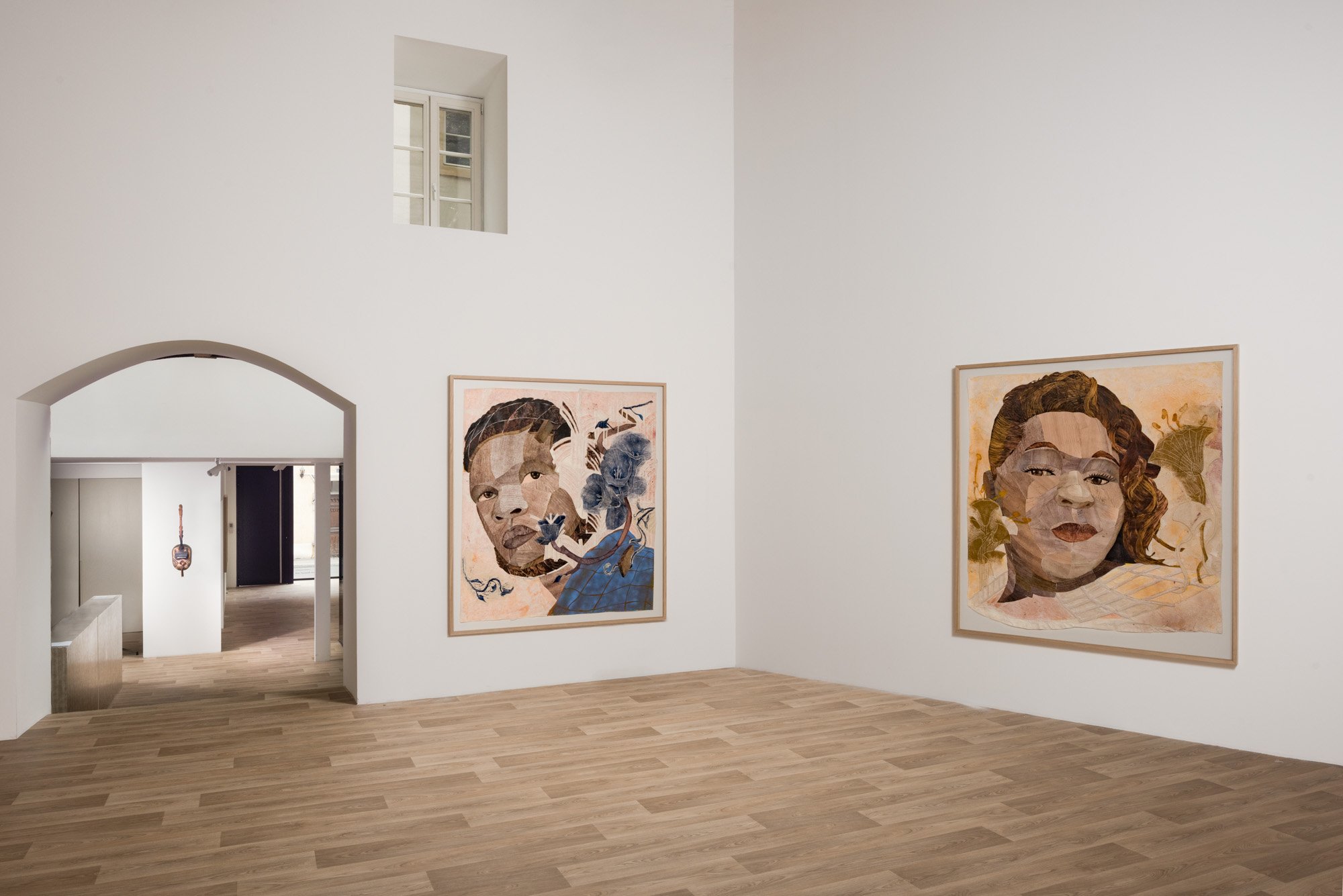
We Hold The WildFlowers: 2022
Zidoun-Bossuyt Gallery - Luxembourg
Klos, born in Chicago Illinois, had reconnected with the patrilineal side of his family through a DNA test only four years prior to the exhibition. Klos’ employs a unique process of constructing collages made of his own woodblock prints to mine his family history through portraiture. Like many African American families – Klos’ family moved from the South during the Great Migration, for jobs in Detroit’s Auto plants. The city grew quickly- propelled by its Black population. The demand of capitalism would soon ship these same jobs over-seas; downsizing Detroit’s factories and abandoning this work force. Today, the city’s abandoned buildings and land plots are being reclaimed by the weeds and wildflowers native to Michigan prairie land.
Klos employs images of these wildflowers as reference to that same sprawling migration, and to the resilience of the Black population who built the American Midwest through industrial labor. Conversely, Detroit also has many well-maintained landmark buildings in the Art Deco architectural style that arose during the city’s industrial growth. Klos references the city’s once ambitious identity through Art Deco design patterns, which haunt the pictorial space from the background, and often appear impressed upon the faces of his portrait subjects.
In the artist words…
“One’s identity cannot be separated from the geography around them. Just as the environment is built by people, the environment in turn – builds us.”

OUR LABOUR: 2022
Ruth and Elmer Wellin Museum of Art - Clinton, NY
OUR LABOUR builds upon the artist’s recent explorations into the intersections between the human form, the natural world, and the built environment. A Brooklyn-based artist who was raised in Chicago, Klos employs a process of collaging woodblock prints to engage ideas about Blackness as a constructed identity and as an adaptable material for survival. Foregrounded in a series of print-based and sculptural works created especially for this exhibition—including the collaborative mural When the Parts Untangle realized with the assistance of Hamilton students—the exhibition considers how familial, geographic, and narrative histories inform notions of identity. This body of work is inspired by a recent life-changing event that led Klos to gain a deeper and more nuanced understanding of his family’s multigenerational history working at the Ford Motor Company in Detroit. The work on view incorporates representations of aunts, uncles, cousins, and other relations— both figuratively and metaphorically—alongside mechanical and natural elements such as car engines, gears, flowers, and vines. Klos’s approach is a means of both untangling and connecting his own complex and sprawling genealogy. With this exhibition, Klos also introduces works conceived around an examination of labor through both deeply personal and historic lenses.

How We Hold It All Together: 2021
UTA Artist Space - Los Angeles
Klos, a Brooklyn-based Chicago native, created this body of work while living in Los Angeles during the pandemic. His works are full of illusionistic depth and space, appearing to be images of sculptural forms built from wood scraps, crystals and brick. Klos’ figures challenge singular notions of identity, as he often merges his own features with those of his models.
“Many of these images are of the family I’ve built throughout my life,” said Klos. “Being raised with very little family, I’ve learned that ‘family’ members are the people who we survive with and for.”
Avoiding direct portraiture, Klos depicts these ‘sculptural models’ of identities as if built from the construction materials of urban detritus. He employs a unique paper construction process by carving into blocks of wood, then inking and printing the relief surface onto archival papers. This source material is then collaged in several layers to create fractured planes.
Klos refers to Chicago’s urban planning for racial segregation through grids and axonometric block forms. Viewers witness heads falling from, and breaking through, grids of wood planks and bricks — as if being born from or negotiating their existence within these building materials.

As Below, So Above: 2015
Jack Tilton Gallery - New York City
“As Below, So Above” is the inverse of “As Above, So Below,” a quote from an ancient Egyptian text on alchemy. If alchemy is the science of converting base metals into precious metals, Klos’s alchemy is made evident through his process and materials: he transforms flat paper into something dimensional and monumental. The materials he references, 2 by 4s, cinderblocks and rocks, defy their functions as practical construction debris and often appear to defy gravity as well, becoming animated and possessed. The mundane become mystical.